 Solutions for all joint sizes
 No wet Weather delays
 Non staining, Easy clean
Successful Porcelain Paving Installation
Substructure & Bedding
There is a lot of useful advice and information available from many sources in the UK, on the use and installation of external porcelain paving, so this is not our focus. For assistance we recommend the UK’s only fully independent source of natural stone and concrete paving information, which has extensive information on the correct installation of all types of paving in the UK, with special sections on external porcelain tile paving. This is the excellent www.pavingexpert.com/porcelain-paving.
A word of caution: beware of similar named website imitations of this still superb trade advice site, which have more recently created by Online merchants trying to cash-in on the original www.PavingExpert.com ‘brand’ and the name of the late great Tony MacCormack, and which unfortunately the internet does not yet police properly!
The suggestion that porcelain tile grouts must be totally impermeable when laid on full concrete beds rather than consolidated granite chippings as prevails in Italy for example, is also a bit of a ‘red herring’. This is explained in detail by an excellent article by the paving expert Tony McCormack at www.pavingexpert.com
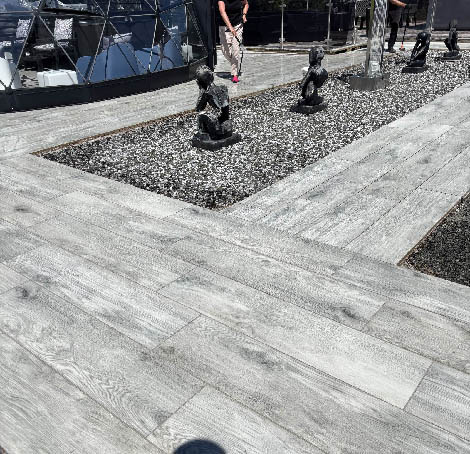
In principle this is a red herring and irrelevant because porcelain tiles should be laid to falls of 1 in 60, like honed sandstone paving, which is because this is very smooth and ‘polished, so it is very slippery when wet, as well as being very porous and easily stained unless it is sealed – ideally before installation or grouting. Therefore, this is also much higher for external porcelain than the falls of 1 in 80, normally used for most natural stone and concrete paving. The reason is again, to prevent water and water borne dirt and residues standing or ‘ponding’ on the surface, increasing the risk of staining and the other sort of falls, slips and trips etc. This increased fall ensures fast surface water run-off into the drainage system. Additionally the now established UK method of laying porcelain with an SBR or proprietary bonding slurry on the backside, laid directly into a full wet mortar bed, also prevents any possible theoretical water underflow, along the bondline, as this is now impermeable and watertight. In any event, as of May 2022, in the records of the PavingExpert, there is absolutely no evidence of any sub surface freeze-thaw damage to paved surfaces anywhere throughout the vast majority of the UK. The substructure and bedding used for external porcelain tiles is therefore normally much the same as for most other types of quality ceramic and natural stone paving, e.g. in requiring a sound substructure to take the anticipated load, a suitable bedding mortar, and then using an SBR Slurry Bonding bridge ‘wet-on-wet’ to ensure the secure bedding of porcelain paving tiles. However, the jointing of external porcelain requires special consideration due to the nature of this material, and we have tried to outline below in an evaluation of the available options for you to consider (or not!):
External Porcelain Tile Paving Jointing / Grouting:
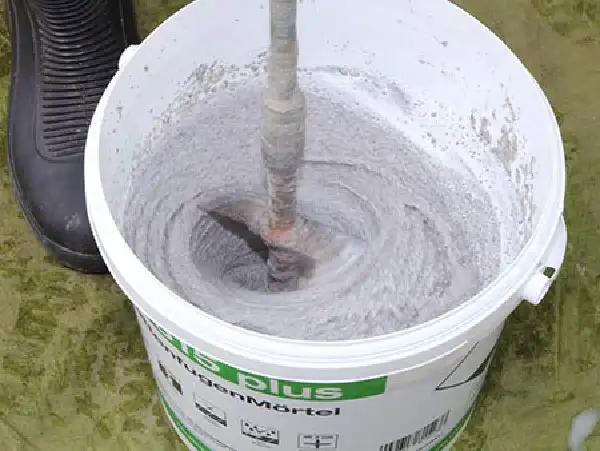
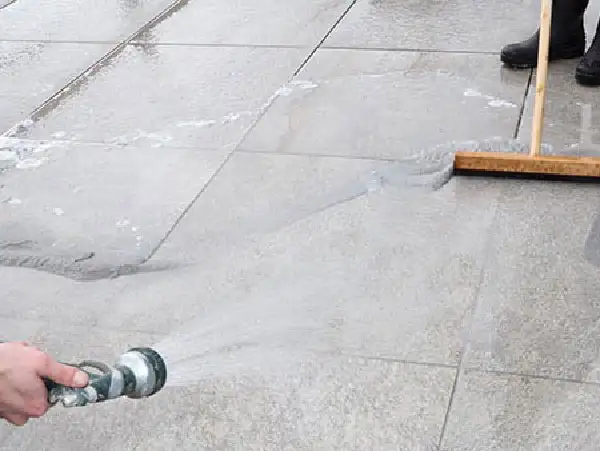
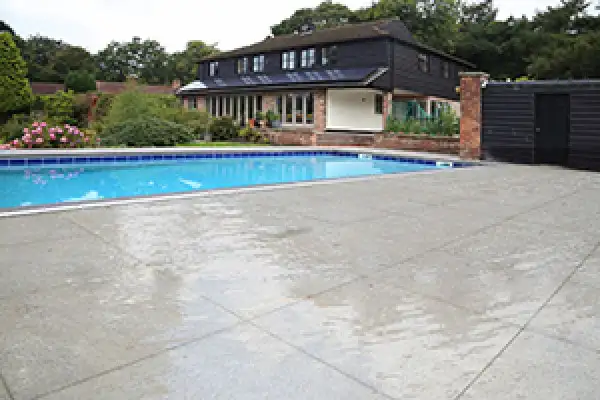
There are two keys to the long-term success in the jointing (also called grouting or pointing – same thing) for external porcelain tile paving - the material must provide relative Ease of Installation to prevent errors and unnecessary additional work on site, and then the jointing material itself must be stain resistant and able to withstand water-jet cleaning to have the necessary long-term performance for Durability in Service.
1. Ease of Installation: For external porcelain tiles it is essential to always use an equally high-performance jointing material. This means not only selecting jointing that is easy and fast to apply, including in the variable British weather conditions, with showers and rain in the forecast much of the time. It also makes sense to use a non-staining paving joint mortar one with minimal requirements for cleaning the residues, or residual haze from the porcelain surfaces.
2. Durability in Service: As mentioned above regarding the need to frequently clean porcelain surfaces, which will inevitably involve jet-washing sooner or later,, it is sensible to select a jointing mortar that will stand up to frequent jet washing. Unfortunately, ALL of the 1-component, air-drying, paving joint mortars (also often called brush-ins, or vacuum packed, bag-in-a-pail types or 1-part ‘resin’ jointing compounds etc., are just not durable enough to be recommended for the long-term grouting of external porcelain tile paving.
In the UK today, porcelain paving jointing is still carried out with all available material options, including from site batched sand and cement, to pre-bagged cement paving joint mortars, plus various forms of tile gout 9good for indoors, but because it is waterproof it does not make it suitable for outdoor use with UV exposure and thermal movement to cope with. Then there are all the 1-part, air-drying compounds now widely available on the market, plus high performance, 2-part, epoxy resin based joint mortars.
So, there are many different technologies, types of material and brands of products used for external porcelain tile jointing, though unfortunately many of these are being oversold and / or recommended for this application, which in reality, is at or beyond their limitations. We will explore and explain this on the pages of this website. It is also perhaps unfortunate, or at least a factor in these issues, that external porcelain paving is a relatively new and recently burgeoning trend in the UK, which has grown out of all proportion to other paving systems in the last 5 years, especially since the lockdown paving boom from 2020 to 2021. As a result, much of the market experience for owners and their contractors, is still relatively new, as it is for paving distributors and stone merchants, now seeing external porcelain tiles make up a very significant part of their business, with the problems and issues with using the wrong jointing material for external porcelain paving just starting to appear. This includes issues arising for professional paving contractors and DIY owners, many believing they have done a good job, now faces with everything from porcelain surfaces that seem impossible to clean after grouting, specifically with cement based mortars, porcelain surfaces that seem to get stained easily, as well as the biggest problem of the joints failing, either by crumbling, by cracking and breaking up in normal service, or being blown out and removed during normal jet wash cleaning operations.
In NCC Group we understand and supply all available paving joint technologies, and we can therefore give unbiased and independent advice on the best technologies to use in each situation for new and remedial works. Therefore, in these pages we have tried to give a balanced view and summary of theses different paving joint technologies and materials, with a detailed assessment of their respective characteristics, performance, and limitations. For full details please see the Paving Jointing pages of this website. However, the following is a brief summary, specifically in relation to their use with external porcelain tile paving:
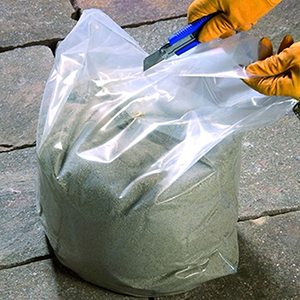
Brush-in Jointing Compounds for porcelain - There are many different brands of these 1-part, ready-to-use, air-drying, paving jointing compounds, such as Geofix, one of the earliest on the market in the 90’s, followed by others such as SikaFix and in recent years EasyJoint and then Joint-it, which have all been heavily marketed and widely used across the UK, including for external porcelain tile paving. However, today nearly all brands of these materials, do not generally recommend their use for porcelain, including the highest performance products on the market GftK vdw 840+ and GftK’s Patio grout, which we supply. This is because, whilst any of the one-component brush-in ‘resin’ paving grout products may well go in easily to the narrow joints generally used for most external porcelain tile joints (e.g. from 3- 6mm wide), but then they will also come out easily too! In many instances, this will be within a disappointingly short time, especially with any direct jet-washing that they cannot fully resist. These materials are also very porous and can easily stain, with food and drink spillages, or grass and plantstuffs dropped and left on the surface, as well as being very susceptible to discolouring with green algae and organic growths. The permeability combined with low cohesive strengths, also means that such 1-part jointing materials are also not resistant to freeze-thaw damage and can break-up in the event of frost. Therefore even the best of these materials such as GftK’s Patio Grout, would likely only last a few years in external porcelain paving – So once again we always ask the question: “Why would you use this type of jointing compound in between expensive and generally professionally installed porcelain tiles….?” Some owners and contractors might think they are an easy solution as at least one variant of these is sold in very garden centre, stone and builders’ merchant, so they are widely available, cheap, and easy to install, sold as a universal panacea …………However, this would seem to be Madness to us! – We do not even recommend our own Patio Grout for these applications, and this is the highest performance 1-part, air-drying paving joint product on the market. Additionally a lot part ‘resin’ brush-in jointing compounds contain linseed oil and other ingredients that darken and stain natural stone, and they also tend to leave a haze over the porcelain surfaces, which can also be difficult and time-consuming, and therefore expensive, to remove after installation. So, …..Why would you do it…? Best avoid one part, air-drying, paving joint compounds for porcelain paving!
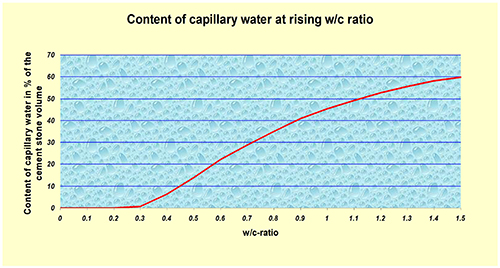
External cement-based paving grouts / jointing mortars are considered suitable for external porcelain and indeed they are widely used throughout the UK, BUT these are also not ideal, as like all cement mortars they have some poor performance characteristics. This also includes the recent crop of so-called, hybrid cement-based grouting mortars - ‘hybrid’ in this context is just a bit of ‘Marketing-Speak’ for some products, which simply means that they have a bit of polymer added as a plasticiser, which ALL prebagged, cement based, paving jointing mortars now do to reduce their natural tendency to shrinkage and cracking! However, these are still cement, hybrid-polymer-modified or whatever, with all the advantages of cement products such as low cost and high compressive strength a low permeability, but unfortunately, they also have disadvantages in relation to paving jointing and specifically to porcelain! Indoor cement tile grouts are not sufficiently durable for long term external exposure i.e. they lack flexibility and crack due to the wider outdoor temperature variations and thermal cycling e.g. from the sun; cement-based grout will also stain easily with typical patio spillages such as red wine and BBQ foodstuffs on patios and terraces. Cement based paving jointing systems used for external stone paving, including porcelain, generally has more cement with graded sands, made smooth and flowable with plasticizing polymers. Unfortunately the key weakness outside is residual water in the joints or washing down or sudden rainfall, which destroys the carefully designed water to cement mix ratio, and this will lead to cracks on site, maybe only visible after a few days and the contractor has been paid and moved on! There is also the issue that in any event, any dense substrates, so especially like porcelain, will have only limited adhesion to cement mortars and so once again, this makes shrinkage cracking and debonding due to normal thermal movement likely over a relatively short time, particularly at the top of the joints – which is of course, the last place you want any cracks!
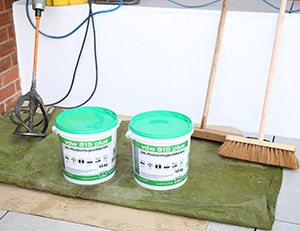
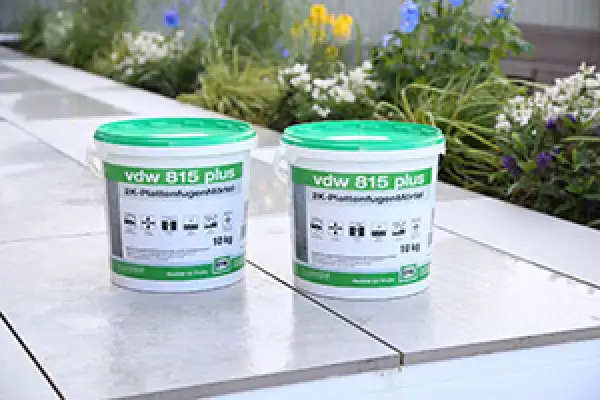
2-component, epoxy resin based, resin bound paving jointing mortars: The best and most technically sound solution for good quality, high performance, external grade porcelain paving jointing in our experience, is a high performance, 2-part, epoxy resin bound, graded fine alluvial sand based jointing system. This unique technical solution is provided by using the most appropriate GftK Paving Joint Mortar according to the porcelain tile joint widths i.e. 2-part, epoxy resin based, GftK vdw 815+ or GftK vdw 850+, for joint widths from >3mm or >5mm respectively, which are undoubtedly the best we have seen for durable external porcelain tile jointing / pointing., without cracking issues. Cement style shrinkage cracking is always a ‘none-issue’ with GftK’s 2-part, vdw range of epoxy resin jointing products. The only permeability related issue for the UK, only happens with 1-part, vacuum packed paving joint compounds; as these will quickly discolour and allow algae and other green growths to collect in the pores and as they cannot be jet-washed and cleaning chemical discolour them, the green discoloration cannot be removed – another reason to avoid this type of inferior products for quality porcelain paving!
Case Studies
Porcelain Patios
This homeowner in Bury, was very proud of his beautiful, new and extended porcelain patios but, unfortunately they...
View Case Study
Porcelain Patio Refurbishment
The owners of this property, in the picturesque village of Croston, in Lancashire, were desperate to find...
View Case Study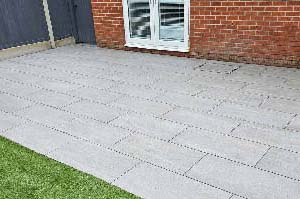
Porcelain Patio & Pathways
The stylish and linear design of this garden in an exposed location, a few miles inland of Garvin on the...
View Case Study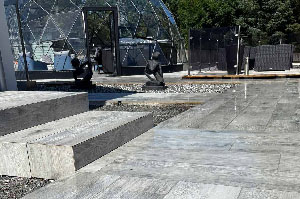
What makes NCC Streetscape Different?



We provide the best paving jointing solutions for all types of paving in all types of areas, and joint sizes. This includes optimum solutions for jointing and repointing works in all domestic, commercial, and public paved areas.
We are the Exclusive UK & ROI Agents & Suppliers of GftK GmbH., the global technology leaders in paving jointing, with unique products that allow quick and easy application, even in wet weather, then provide high performance and extended durability for a long service life.
We provide FREE Expert Technical Advice to select the right product on every project, with additional guidance to prepare and successfully complete the job, including our renowned training and site support service.
We have a reputation for quality, reliability, and service, from professional paving and landscaping contractors, specifiers and authorities, as well as our and DIY customers.