
Paving Sealing FAQS - Online Shop
As can be seen in these pages, there are several different types of Paving Sealer in terms of their chemistry and technology, and they all may have their place for different domestic and commercial pavement sealing applications and requirements, which can also be different for example when you are sealing newly installed paving or looking to refresh and refurbish existing paved areas. It is therefore important to be extremely clear in defining your specific paving project's sealing requirements, and in terms of application of the sealer, and the performance of the sealer in service – It really is ‘Horses for Courses’
It my sound pedantic or over the top, BUT we always say that writing these requirements down is best, especially if you are dealing with someone else, they could be your client, or they could be your contractor. It is best that everybody involved and understands and can ‘remember’ the same requirements, selection decisions made and why! You can then properly evaluate the alternative solutions using the different material technologies available, together with their respective advantages and disadvantages.
We have prepared a Checklist to help in defining your requirements and the key selection criteria for your paving sealing project - the following aspects should always be included in your assessment – A copy of this is also available to download in PDF format below:
NCC Paving Sealers Checklist - for Project Assessment
For my Paving Project:
- Type of Paving e.g. Natural Stone or Concrete? If natural stone then what type, and what size elements and with what type of paving joint mortar…?
- New or Existing / Refurbishment?e.g. Is the paving new and recently laid, if so, when? If it is a refurbishment, has it been sealed before and if so with what, are an areas also newly laid as repairs or repointing etc….?
- Surface conditions – e.g. Is the surface clean or does it need cleaning and if so, what needs to be removed is it dirt and grime, green growths, blackspot9lichens) or other types of staining and if so what…? If the surface needs to be cleaned, does it need repointing after cleaning…? Always check after cleaning and use a suitable repointing mortar.
- Surface permeability / porosity – e.g. Is the surface permeable / porous – Yes, or No ? …. Somewhere in the middle...? What does this mean ….? How do I decide…? (There is a simple droplet test for porosity - see web page)
- Traffic Anticipated – e.g. is there pedestrian only or pedestrian and vehicular traffic over the area – What is this– foot traffic only / cars / other….?
- Traffic Frequency – e.g. Is this area continuously or infrequently trafficked and is this every day or only occasionally….?
- Durability – e.g. What is the service-life required before and replacement or recoating / refreshing of the paving sealer…….? How easy is it to access the area and also to close it for any such future maintenance and recoating...?
- Visible Finish required– e.g. Do the owners want the seal to effectively be invisible, or maybe to enhance the finish or even to give the surface a gloss finish – also known as a wet-look (not recommended - see webpage)
- Colour Enhancing – e.g. the colour is enhanced but without a temporary gloss look than can soon wear off and in patches to look very unsightly?
- Access and Site – e.g. Are there any access or other local restrictions, or any sensitive adjacent surfaces / equipment / planting ...?
- Weather Conditions – e.g. What time of year will the paving sealer be applied and what will be the likely temperature (maximum and minimum) during the application and drying, if rain is a possibility can the area be covered and protected….?
- Environmental Conditions – e.g. Are there any other exposure limitations or considerations for application and/or in service….?
View & Download a PDF Copy of the NCC Paving Sealing Checklist View/Download
How to Test Paving Permeability / Porosity
A simple water droplet test to confirm if you really need to seal your paving………?
This simple test is what our technical specialists recommend to quickly check and assess the porosity, or not, of paving surfaces when on-site, plus this is also a very good way to find out how easily water borne salts and stains will behave on your paving; it can also be assumed that oil-based stains will generally always be more penetrative - as an easy clue!
This is a simple surface permeability / porosity / absorbency test that is widely known as the Water Droplet Test. This was originally developed for use in the resin flooring industry, where it can be critically important for the resin primers to penetrate the concrete base slabs, or the resin floor will not have sufficient adhesion. In preparation for seriously expensive resin flooring works, this pre-testing and substrate evaluation is carried out very precisely using a pipette and strictly measured, timed, and controlled as shown in the examples below. Whilst paving sealing is not in the same league of costs or detailing as resin flooring, a variation of this test can easily be made on site to confirm the porosity or otherwise of the paving elements before sealing them. The key information gained will be a good visual understanding of how well any water and/or water borne de-icing salts or stains, including the ubiquitous red wine, will also be able to penetrate and damage or disfigure your concrete blocks or natural stone. If water does penetrate easily and continue to be absorbed into the surface, then you would be well advised to consider the use of a paving sealing solution to protect your investment and maintain its good appearance!
Testing – This involves the application of single droplets of water onto the concrete / stone paving surface, whilst closely observing the behaviour and any movement of the droplet, whilst timing and monitoring the rate of absorbency into the substrate. This gives a good indication of the surface density and permeability, and if a paving sealer might be a good idea.
To correctly carry out the Water Droplet Testing, use a pipette or suitable dispenser and make groups of approximately 6 water droplets in different elements and areas of the paving, including on any areas that are discernibly different in appearance, texture, or profile (to check consistency in results – or more importantly variations in permeability that are always possible and best found with water now, rather than later with oil or red wine etc.)
Place the droplets using a simple ‘dropper’, syringe, or pipette (available from any chemist) type dispenser to suit, positioning them together within an area approximately 10cm x 10cm, be sure to always test at least the centre and the perimeter areas of your paving elements with different groups of droplets if necessary, and according to their size.
Example of Droplet Test on Dense Paving Surfaces
(i.e. smooth, hard and almost ‘shiny’ surfaces)
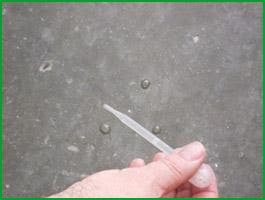
Water Droplets: Pipette Application
Note - No immediate absorption!
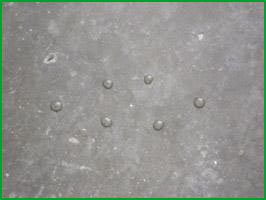
Water Droplets: 5 Mins Later
Note - No absorption evident!
If these were the surfaces of your concrete or stone paving, then a surface sealer is probably not required as water cannot easily penetrate and therefore the paving will be resistant too frost damage, plus as water cannot penetrate then it is most unlikely that the surfaces will be stained either.
Example of Droplet Test on Open-textured Paving Surfaces
(i.e. – surfaces that are ‘dull’ and not shiny in any areas, such as those that have been riven, sawn, or which have already been mechanically prepared e.g. by blastcleaning or grinding etc.).
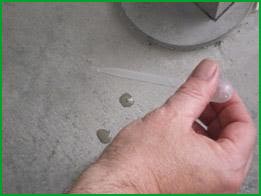
Water Droplets: Pipette Application
Note – Absorption is immediately visibly evident
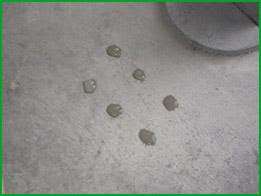
Water Droplets: 5 Mins Later
Note: - Absorption continues & diameter of penetration increases
These clearly porous concrete or natural stone paving elements are therefore highly likely to benefit from, or perhaps even need the application of a suitable sealer to prevent water penetration and future damage and / or being disfigured by unsightly and unhygienic staining.
So - A simple test and a good way to help you or your customers decide what makes sense for your paving projects. We hope that you find this additional information and advice helpful for your project.
For any more information on Paving Sealing for your specific project, please call 01257 266 696 for our FREE expert advice and assistance.
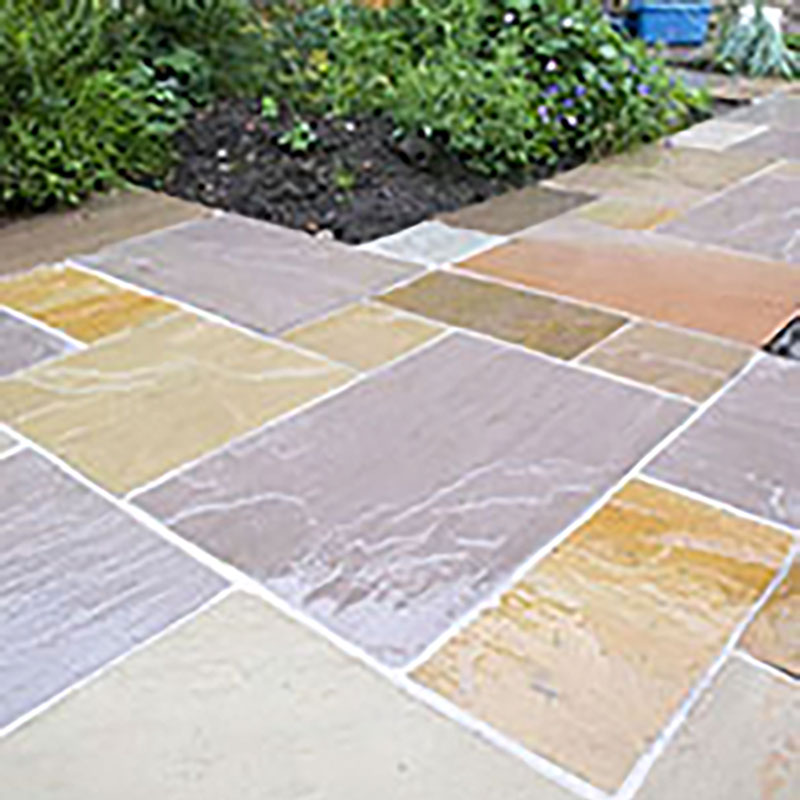
Paving Sealers – A Technical Summary & Selection Guide:
To provide more information on each of the alternative ‘Categories of Paving Sealer’ and the different ‘Types of Paving Sealer Materials’, we have summarized the main characteristics of the different Types and Categories of Paving Sealers for concrete block natural stone, and external porcelain tile paving below:
- Impregnating Paving Sealers – impregnating paving sealers are designed to penetrate completely and not to leave any significant film on the paved surface. Today these are usually based on silanes, siloxanes, fluorosilicates, or a blend of these materials dispersed in solvents or water, which is designed to penetrate and impregnate the pores and capillaries of the paved surfaces, forming a hydrophobic (water repellent) and oleophobic (oil repellent) finish.
- Surface Coating Paving Sealers – surface coating sealers for paved surfaces are designed to penetrate somewhat and / or to bond (e.g. on dense basalt or porcelain surfaces) to the open texture of the mineral substrate that makes up the paving element. There is always some dry film thickness of the material that remains visible on the surface, and it is this that can give a matt or gloss (wet look) finish to the surface. This film can also be tinted for products designed to ‘enhance’ the appearance. This type of paving surface sealers are usually based on Acrylic or Polyurethane resin materials, which again can be dispersed in suitable solvents, or increasingly with water due to the increasing H&S restrictions on solvent use.
These different categories of Impregnationg Paving Sealers and the film-forming Surface Coating Paving Sealers, each then also include a range of different types of materials technologies as indicated below. The different characteristics and properties of these different types of paving sealers and materials technologies, together with their respective advantages and potential disadvantages for your paving sealing project can be further summarised as outlined below:
Paving Sealing Technologies
‘Impregnation’ Type of Paving Sealers
Paving Impregnation sealers are usually designed around hydrophobic and oleophobic materials, and a based on Silanes, Siloxanes, Fluorosilicates or a combination of these materials. The range and cost-performance of the products on the market varies widely, as these include the much advertised and so-called 'Water Repellent Silicone Sealers', which NCC Streetscape would never recommend and will not supply. They can impregnate only for a short depth and do not react and bond so will last only a very short time, not even the summer in many cases, as they are quickly broken down in sunlight and can be flushed out by water jetting e.g. product like Thompsons Waterseal, or similar such equivalent private labelled Builders Merchants rubbish that can be demonstrated to work the day after they have been applied – try it 3 months later! - Please Do Not Use these inferior products unless you want a tatty looking job, are moving to a new house, or if you enjoy complaints and redoing the work!
Recommended impregnation materials for invisible paving sealing include water-borne Fluorosilicate ‘Pore Strengtheners’ that also bond into the structure and increase the paved surface resistance to wear, in addition to reducing the permeability. Alternatively, there are the water and/or solvent dispersed Silane and Siloxane based Paving Sealers, which will give good long-term water repellence and therefore also provide good long-term resistance to water-borne staining, as well as against frost or freeze-thaw, including de-icing salt resistance. The solvent based products are always going to be more efficient in colder weather and higher humidities and will generally have higher penetration properties – But solvents are increasingly restricted and expensive because they are not so environmentally friendly, so a great deal of investment and development has gone into producing the latest water-borne equivalents that NCC supply.
The main advantage of the impregnation products is that they penetrate fully into the paved surface and then work by bonding with and lining the pores of the concrete or stone paving, then due to their hydrophobic nature they are very effective at repelling liquid water; but without changing the surface appearance, or preventing water vapour transmission, plus many are also oleophobic, meaning that they also repel oil based staining. Efflorescence is also prevented or greatly reduced for concrete block paving, and the natural appearance is retained by natural stone surfaces, plus these impregnating products can be used safely on all types of porous and sensitive natural stone paving. The impregnating paving sealer type products from NCC Streetscape will last for many years and then they can also easily be refreshed, by simple re-application at any time in the future, whenever this eventually becomes necessary, which will be in several years in most situations.
In our experience and depending on the exposure, type of traffic and cleaning regimes this is only likely to be required after many years as the performance in service is excellent. For your additional information and comfort, this type of materials technology is also used throughout Europe, the USA and elsewhere in the developed world for the protection of reinforced concrete bridge structures against water ingress and damage due to de-icing salts and frost damage. Several of these materials are therefore now approved for this purpose by different National Highways Agencies, and this includes Highways England and the Department of Transport in the UK.
The only disadvantages in terms of impregnating sealers for paving protection is probably that there is no additional ‘enhancement’ and certainly no ‘wet-look’ achieved other than during application, which is of course very often a key advantage. However as a clear penetrating impregnation, the protection is not always visible and easily monitored, other than by its performance every time it rains! – So this is a very durable paving protection solution based on a totally different concept to the normal ‘visible sealer’ approach, by providing ‘invisible sealing and protection’ – These products are therefore usually the best solution for those who do not really want to seal their natural stone or make a glossy (albeit somewhat temporary) concrete block driveway, but who definitely do want to reduce staining and prevent frost damage to their paving.
Even the aforementioned ‘natural stone enthusiasts’ can frequently understand and agree with this approach, and so these impregnation sealer type products are increasingly considered acceptable, much better and increasingly preferred for stone protection in the modern environment. They will provide a high level of protection, maintaining the natural stone appearance, through effectively sealing the paved surfaces internally. Whilst certainly not cheap, their cost should always be considered in relation to their ‘invisible’ protection, extended service life and the ease of eventual reapplication, but which is only required after many years, all of which seems reasonable to us.
‘Surface Coating’ Type Paving Sealers:
The two most prominent types of ‘surface coating’ paving sealers materials technologies are either Acrylic Resin, or Polyurethane Resin based, both of which are available as water dispersed and solvent dispersed products. In principle the solvent dispersed materials are a bit higher performance and used to give longer durability, but the newer technologies in NCC Streetscape’s Paving Sealers using water dispersed materials, are now more than equal in performance and much more environmentally friendly to apply and in use.
Acrylic Paving Sealers
These are relatively cheap products and easy to apply. A matt sheen or gloss ‘wet look’ (albeit temporary) for the surface is normally achieved with 2 or 3 coats (subject to the substrate porosity and profile that determine consumption). Acrylic resin-based sealers are available as both solvent and water-borne products that means the resin is distributed and carried into the concrete or stone substrate, and the solvent or water then evaporates to leave a thin, residual dry surface film sealing coat. This gradually reduces in thickness during service, primarily through wear (abrasion) and UV light degradation from the surface during normal exposure and weathering, usually over a period of around 2-5 years, according to the paved areas type and level of traffic use and environmental exposure.
Acrylic Paving Sealers all have the disadvantage that the surface coating film is not particularly tough to resist traffic abrasion, and so any frequently / heavily used areas can soon wear and this worn trafficked area can become visibly ‘different’. This is especially the case with gloss finish ‘wet-look’ sealers.
A very wise old paving man once said: “If you like your paving with a wet-look, then why not just wet-it ...!” Conversely, when the gloss surface appearance is dulled by foot or vehicle traffic wera, it can easily be refreshed by cleaning the surface and simply over-coating with a refresher coat. However, this visible wear is very much less apparent when a matt or satin finish sealer is used so these types of acrylic paving sealer are the standard types that we recommend. It should also be stated that although the appearance may have been affected in this way, the protective capability is largely retained, and any water penetration or staining will continue to be greatly reduced. Additionally, even though these acrylic sealers will all require eventual re-application in 2 to 5 years depending on the traffic and exposure, this is also easy and relatively cheap to do with all of the acrylic resin based paving sealers. In fact this is sometimes claimed as an advantage for acrylic sealers over poyurethan resin ones for example, as their surfaces continue to cross-link after application, which makes them harder for sure, but they also require expensive blast cleaning or dangerous solvent reactivation for any overcoating too! Our selected acrylic resin based options are NCC Stone Sealer and the NCC Streetscape Stone Sealer (solvent dispersed) and NCC Stone Sealer and Enhancer (water dispersed), which are both available in our Online shop.
Black Limestone Paving Sealing and Restoration - In recent years there has been a bit of an explosion across the UK in the use of 'natural' Black Limestone paving that is very attractive and works well with many garden designs and like all limestone surfaces is generally reliable and hard wearing. The only issue in fact is that the beautiful black (well very dark grey) paving, only stays black in the ground as the bedrock, that is naturally never exposed to UV light and weathering, and this dark grey, black when wet, very attractive colour only lasts a little longer than the paving installation and grouting period......! Lots of contractors and stone dealers have had a lot of complaints, but this is not really or necessarily their fault, as even limited research will tell you this is the situation. Technically this is as a result of both atmospheric oxidation of black carbon-based pigments in the rock, with simultaneous UV light in the sunlight simuktaneously bleaching the surfaces and so it goes grey. When wetted again by rain or hose, than the underlying black pigment colour in the stone is refracted through the water on and in the surface pores, and so the paving appears to be black again – Magic!
As we all know: 'The customer is always right', and interestingly the stone is often strangely cheap (now guess why...?), and yes this phenomenon is well known, but only to those of us who regularly handle and work with this stone paving, which is mostly imported from India and China. So if we were now going to give it the right descriptive stone paving name, this should probably now be called: ‘Black for a few weeks after laying flat on the ground if you are lucky, or when it is completely wet Limestone Paving, otherwise and when dry this is really Light Grey Limestone Paving’. It is fine durable paving – BUT IS NOT ALWAYS BLACK.
As a result of this apparent deception and dodgy dealing being inferred, there are many people around the country that are somewhat disappointed with their black limestone patio, well in terms of its light grey colour anyways. - Otherwise it is usually fine light grey paving, black when wet though, so at least a fair percentage of the time here in the UK! In recent years there have been numerous products from paints to stains that have been produced to make the light grey limestone go ‘Back to Black’, usually based on black pigments in an acrylic resin dispersion (same basis as gloos black sealers). The clue to one of those sold widely is in the name! However this product and other versions of this, all tend to give a glossy finish after using them to bring the black colour back on the exposed surfaces – Once more and in the same way as other glossy acrylic paving sealers, this looks and is great, until you walk over it a bit and the trafficked area becomes clearly visibly and soon you have a different sort of unsightly result! – We think it looks worse than the light grey that is at least black every time it rains, just not when you are using your patio in the sunshine!
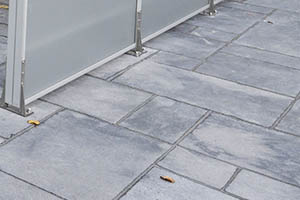
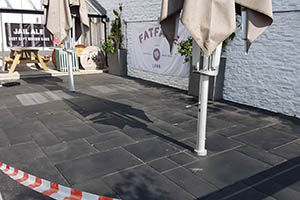
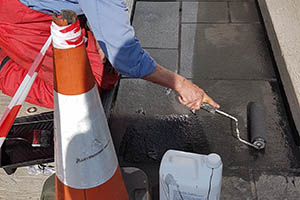
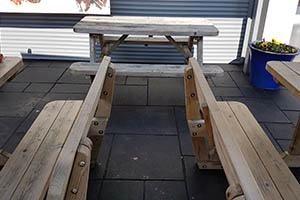
However, we have worked with some clever resin specialists and a couple of years ago they came up with a much better water dispersed, acrylic resin based product that gives a deep and dark, but matt finish, which is also very resistant to foot traffic across it. Indeed, we did a field trial on a popular Devon Pub’s Beer Garden Terraces a few weeks before their annual Music Festival in May 2018 - and as you can see in the pictures, it has stood up to this and other pub garden type traffic, with multiple spillages and general paving surface 'abuse' very well. This is now called NCC ‘Return to Black’ Stone Sealer, and is available in our Online shop.
Polyurethane Paving Sealers
Also called PU Sealers, these were traditionally the higher performance, solvented paving sealing products, which were originally designed for professional application and use in strictly dry and controlled conditions only due to some necessary levels of isocyanate content, plus they came with a seriously higher price – Well somethings don’t change! – So if you are ever offered a ‘cheap’ Polyurethane (PU) Resin Paving Sealer – Forget it!
However, this original PU technology did and does provide a surface seal with long term durability, plus it can also provide substantial sand stabilisation on ‘flexibly’ laid concrete block paving. These are undoubtedly the best visible gloss or satin finish paving sealers for many commercial applications, but unfortunately these good quality polyurethane resin based paving sealers are also correspondingly very much more expensive. However, this should be considered together with their increased performance properties – so when viable on commercial applications the best performing polyurethane (PU) resin, product is generally agreed to be Resiblock 22, which is also still solvent dispersed to ensure the PU resin's penetration into the concrete surfaces and to mitigate against the adverse effects of any residual moisture, which is a potential issue because polyurethane resins are extremely moisture sensitive and so their limitations and controls during application and curing are critical. Not at all recommended for DIY applications, for all of the above reasons, but we can happily discuss the requirements and possibilities of arranging the professional application of these materials with you when appropriate. If this is of assistance, please call 01257 266696 or email technical@nccstreetscape.co.uk
Paving Sealing Product Pages
Additional information and all the specific product performance details and characteristics are given in the respective PDS available to view and/or download on their respective product pages above. Please select the most suitable product for your project and then you can order online in our Online shop.
NCC Water-based Paving and Patio Sealer NCC Stone Sealer NCC Stone Sealer & Enhancer NCC ‘Return to Black’ Stone Sealer GftK vdw 950 3-in-1 NCC Porcelain ProtectorAlternatively, for more information and FREE advice and assistance on your paving sealing project requirements, please email us at technical@nccstreetscape.co.uk or you can call 01257 266696 for advice.
Concrete Block Paving Stabilisers & Sealers
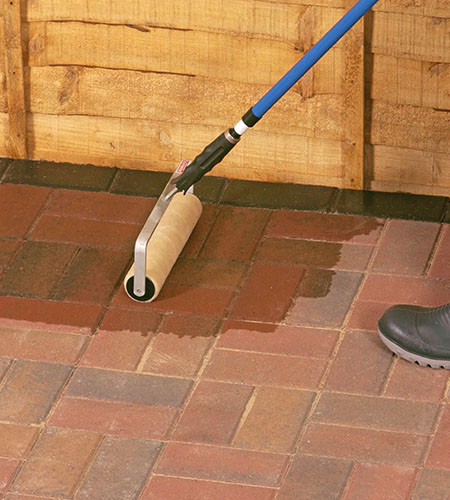 Block Paving Sealers are not the same thing as “Paving Jointing Sand Stabilisers”, as a “Paving Sealer” is specifically designed and developed to penetrate the blocks and fill / seal them at a fine micro-pore / capillary level. Whereas, whilst a sand stabiliser may penetrate the larger capillaries of concrete blocks, the primary purpose is to flow into the joints and bind the jointing sand grains together and to the block edges. This effectively ‘stabilises’ the sand filled joints, which helps to prevent the jointing sand being eroded by weathering and cleaning operations. Paving Jointing Sand Stabilising products therefore need to be less penetrative, but tougher and more flexible and elastic than Paving Surface Sealers, to bind the sand particles together and help to accommodate the natural flexing and movement of flexibly laid block paving (so-called as they are generally laid on compacted sand, instead of a rigid concrete or cement mortar base or substructure). For project requiring a paving joint stabiliser solution, then a correctly formulated jointing sand stabilising product is the ‘GftK vdw 870’ (acrylic vinyl copolymer based, water dispersed jointing sand stabiliser), or the combined sand and polymer based GftK vdw VarioSand. For more information on these different technologies, please refer to our Paving Jointing Sand Stabilisers page.
Concrete block paving sealers, however, can be the ideal solution to helping you to preserve and maintain the good appearance and function of modern block paving in many different areas. The application of a suitable block paving sealer can prevent or greatly reduce staining from oils, grease, and many other oil and/or water-borne stains etc. Technically this is because the application of the paving sealer makes the paved surfaces hydrophobic (meaning it repels water) and oleophobic (meaning it repels oils). As a result surface sealing solutions can be very useful and should probably be far more widely recommended and used for protecting block paved domestic driveways, patios, terraces, and many commercial areas, typically against vehicle oil leaks on trafficked areas, plus against many other stains and spillages, from foods and drinks to grass cuttings and other plant trimmings and residues from gardening works etc.
Sealing the surfaces of concrete block paving to prevent or at least greatly reduce the penetration and ingress of water, will also therefore directly and proportionately increase the resistance of the paved surface to frost and freeze-thaw damage, including de-icing salts exposure. This damage is not always recognised as frost and freeze-thaw damage as such, which is often because this damage usually becomes more visibly evident in Spring and Summer, when traffic increases, the area dries out thoroughly and our attention turns to looking at these outdoor surfaces once again. However, the damage occurred sometime before this, as water in the concrete pores expanded as it froze, or more correctly, as it was repeatedly frozen and thawed inside the blocks, causing fine micro-cracks, then more and larger cracks. Eventually, sometime later, these damaged areas are seen to be either crumbling and breaking down from the surface inwards or delaminating and scaling-off from the surface. These damaging effects are increased and will happen faster when any de-icing salts are used in the area, as these greatly accelerate the chemical reactions that create this effect.
Modern impregnating and surface sealing types of block paving sealers from NCC Streetscape can be used from new when the paving is installed, or much later for their refurbishment – though only and always after thorough cleaning outlined above and on the previous page. Therefore these sealers can be extremely useful in the upgrading and refurbishment of many different block paved areas on their own and/or in combination with NCC’s Paving Cleaners and the GftK Paving Jointing solutions that are also detailed on this website. The different types of paving sealers available for concrete paving blocks include the hydrophobic impregnations that penetrate deeply into the surface and line the pores to repel water and oils, plus the surface sealers that penetrate less deeply, but also form a protective film on the surface, which is why this type can also be used to enhance coloured concrete paving block surfaces i.e. the surface can be sealed and given a matt or gloss finish, we normally recommend a matt finish for areas with any significant traffic, as a gloss or so-called ‘wet-look’ finish can soon wear under any type of traffic – pedestrian as well as from any vehicles.
If you are uncertain of the best surface sealing or sand stabilising solution for your project, then please do not hesitate to call 01257 266696 or email technical@nccstreetscape.co.uk for FREE expert advice.
Natural Stone Paving Sealers - Online Shop
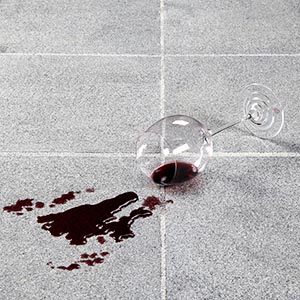 People can be looking to enhance the appearance and colour of their natural stone paving, even to provide a permanent ‘wet-look’ as after a summer shower the colours always seem heightened, more intense and with a glossy wet-look that can seem very attractive, and many people would prefer to keep it this way. However, unfortunately this is usually not easy or straightforward, and is usually not advisable. This is because most glossy stone paving surface sealers that you can use to provide the ‘wet-look’, will subsequently dull and abrade very quickly under any form of traffic – including just with foot traffic. This would soon be very visible as a dull ‘pathway’ through the glossy surface, and it will no longer look so attractive – It is true that such gloss paving sealers can usually be refreshed quite easily with just another application on the surface (after cleaning), you might need to do this more often that you would like – at least annually we would suggest. A better and more durable alternative for most natural stone paved areas might be a paving sealer and colour enhancer with a more matt finish. (e.g. NCC Streetscape Natural Stone Sealer and Enhancer). This does not show or highlight any traffic use areas anywhere near as much as a gloss finish, and so this will provide a longer lasting and more attractive solution over the longer term. This type of sealer can also be reapplied easily when this is eventually required.
On any relatively porous natural stone paving units, such as the sandstones and limestones currently being used for domestic driveway paving, and for many other commercial and public areas with vehicular access, then surface sealing is now highly recommended both to prevent unsightly oil and grease contamination, plus to reduce cleaning costs, and to prevent frost damage. To prevent staining where vehicle or cooking oils, foodstuffs, drinks, and other spillages can occur, and/or to prevent frost damage on this type of porous stone, then sealing with an effective surface impregnation and sealing solution is very highly recommended (e.g. using GftK’s vdw 950 3-in-1, NCC Water-based Paving and Patio Sealer, NCC Stone Sealer, or NCC Stone Sealer & Enhancer).
Natural Stone Sealing before Pointing / Grouting
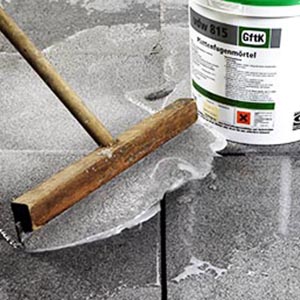
Another recent development made by many professional paving contractors working with porous natural stone, is to use GftK’s vdw 950 3-in-1 StainProtect to treat the paving immediately after they have been laid, BEFORE application of the pointing / joint mortar. This approach has proven to be very advantageous with paving that is known to be, or that can be variably, porous, and so it is known that the use of any cement-based jointing, will cause staining and cleaning problems as well as with brush-in jointing compounds, which are prone to staining as well as being generally just not up to the job. This is detailed elsewhere in the Paving Jointing pages of this website, and one of the 2-component epoxy resin based vdw 800 series mortars from GftK is obviously far more ideal.
For example with the 2-part, epoxy resin based GftK Paving Joint Mortar, it is also important to understand that during application over a very porous stone with a prewetted surface as usual, it is possible that in some of the most porous areas, the liquid resin binder could be partially absorbed, subsequently affecting the visual appearance of the stone (darkening in places). Contractors have discovered that by pre-sealing the stone surfaces once the bedding has set, with GftK’s vdw 950 3-in-1, this very effectively prevents any subsequent absorption of any resin binder. There is also the additional benefit that after the grouting is completed, a sealed and protected stone surface is left, with greatly increased resistance to stains from spillages and damage from frost etc. Plus, there is also no longer any risk of efflorescence through the stone surfaces as the impregnation and sealing is made inside and within the capillaries of the stone itself.
 Important note: The costs of different types of paving sealing technologies and products can also appear to be hugely different. So, firstly always try to not only compare the cost per litre, but the cost per metre applied, including the costs of their different application requirements, and most importantly any costs from their limitations, e.g. polyurethane resin-based sealers can give good results in terms of durability and service life, BUT they require absolutely dry conditions for their application and curing – otherwise they can be a nightmare with delamination and white blooms forming under the coating etc. So, also consider what are the real additional costs of any possible weather delays, or expensive remedial works...?
The final consideration should always be the durability and service life required...? – Are you happy to re-apply a sealer every year, or do you want a much longer service life? The calculated total costs can be far more comparable after all the relevant considerations for each project are considered. In our experience today, the best and most cost-effective options for natural stone sealers are usually either hydrophobic impregnating sealers or the matt finish types of acrylic surface sealers that can now also meet most exposure and performance requirements.
Additional note: At NCC Streetscape we do also have access to many more very specialised cleaning and sealing solutions and processes, but these are generally far more restricted by their cost and/or the necessary equipment required to use them. As a result these are only used by experienced, trained professionals, but if you think you need something more than the excellent products outlined on these pages, or you are uncertain of the best way to approach sealing your natural stone paving, then during normal office hours you call our paving team on 01257 266696 or email technical@nccstreetscape.co.uk with pictures if possible please, for FREE expert advice on the best and most cost- effective sealing options.
Alternatively - If you already know what type of Paving Sealer you need – surface impregnation or surface sealer, please visit our Online Shop.